Model Type Classification
By system and representation
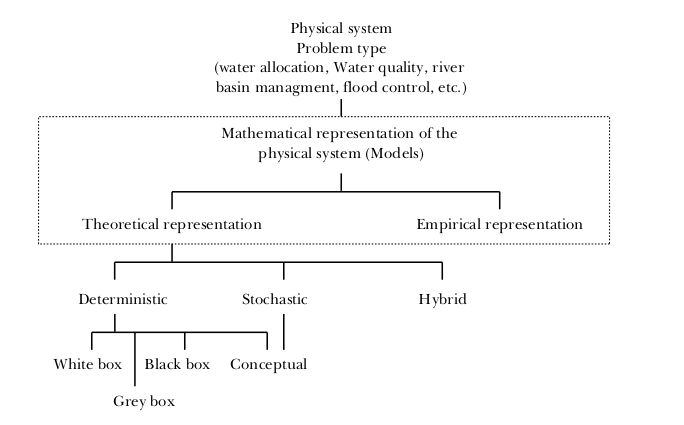
A physical system or problem type (water allocation, water quality, river basin management, flood control, etc.) is captured by a mathematical representation of the physical system — a model. Models can follow a theoretical or an empirical representation, and can be further classified as deterministic, stochastic, or hybrid.
By scale
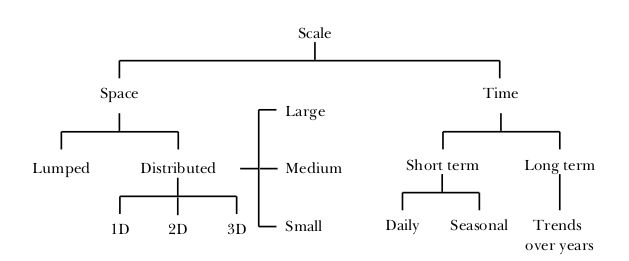
Models are also classified by scale, along both the space and time dimensions: space ranges from lumped to distributed (1D, 2D, 3D) at large, medium, or small scale, while time ranges from short-term (daily, seasonal) to long-term trends over years.
By method of solution
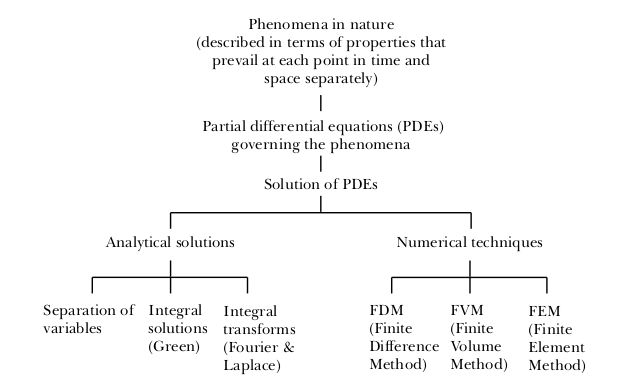
Phenomena in nature are described in terms of properties that prevail at each point in time and space separately, giving rise to partial differential equations (PDEs) that govern the phenomena. The solution of these PDEs can be:
- Analytical, via separation of variables, integral solutions (Green's functions), or integral transforms (Fourier & Laplace).
- Numerical, via the Finite Difference Method (FDM), the Finite Volume Method (FVM), or the Finite Element Method (FEM).