Model Development Process
Developing a model follows a structured pipeline, from problem definition through to post-processing of results.
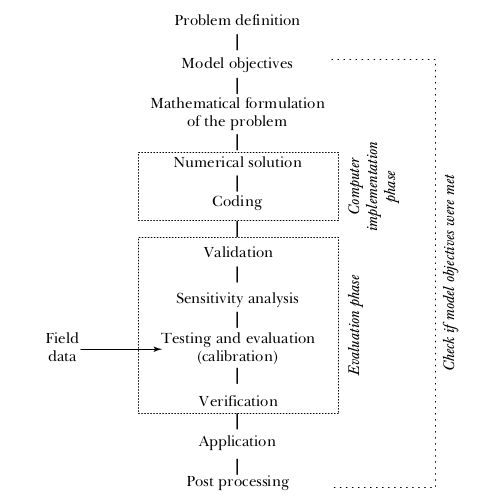
- Problem definition: Define the objectives of the model, which requires that the modeler address the issues posed by the problem to be solved, and determine the type of problem (water quantity, water quality, flood volume, etc.).
- Model objectives: Determine whether a similar model is already available that can be used. If no model is available, a new model must be defined and implemented on a computer.
- Mathematical formulation: Define the mathematical representation of the phenomena that requires solution.
- Numerical solution: Select the numerical approach that solves the mathematical representation of the phenomena.
- Coding: Coding and implementing the numerical solution on a computer.
- Validation: Validation of the mathematical model by checking it against simple examples, including checking the limitations in applicability and the required boundary and initial conditions.
- Sensitivity analysis: Sensitivity analysis for the parameters of the model.
- Testing and evaluation (calibration): Testing and evaluation, performed alongside calibration and verification.
- Application: Application of the model to different problems.
- Post-processing: Presentation of results in graphical format, tabulated format, or animated form to decision makers and stakeholders.